How Spravato Works: A Different Kind of Depression Treatment
Most antidepressants you've tried work on serotonin, norepinephrine, or both. Spravato doesn't. Here is why that matters — and why it can work when nothing else has.
The Serotonin Problem
Since the 1980s, most approved antidepressants have worked by targeting serotonin — either by preventing its reuptake (SSRIs, SNRIs) or modulating serotonin receptors in various ways. Prozac, Zoloft, Lexapro, Effexor: different molecules, same general strategy.
This strategy works for many people. But for approximately 30% of patients with major depressive disorder, it doesn't — or stops working after it initially did. That group has a name: treatment-resistant depression (TRD).
The core problem: When serotonin isn't the issue — or when serotonin pathways have down-regulated after years of medication — adding more serotonin activity doesn't help. You need a completely different mechanism.
What doesn't work about the serotonin approach for TRD:
- Wrong pathway. Depression may involve glutamate dysregulation, not just serotonin deficiency — especially in chronic, resistant cases.
- Takes 4–8 weeks. Serotonin-based antidepressants take weeks to reach their full effect, even when they work — because their mechanism requires gradual receptor adaptation.
- Fails about 30%. After two adequate antidepressant trials, the probability of responding to a third medication from the same class drops significantly.

The NMDA Breakthrough
Spravato targets the glutamate system — the brain's primary excitatory neurotransmitter — which has nothing to do with serotonin.
How researchers think it works, step by step:
-
1
Esketamine blocks NMDA receptors. Glutamate is the brain's primary excitatory neurotransmitter, and NMDA receptors are glutamate's primary receptor type. Esketamine binds to these receptors and temporarily blocks them — specifically the channel they use to pass signals.
-
2
A glutamate surge is triggered. When NMDA receptors are briefly blocked, the brain compensates with a rapid surge of glutamate. This burst activates a different, faster glutamate receptor type called AMPA receptors.
-
3
BDNF is released and synapses regrow. AMPA activation triggers the release of BDNF — brain-derived neurotrophic factor. BDNF is essentially fertilizer for neurons. It stimulates the rapid growth of new synaptic connections, a process called synaptogenesis, in the prefrontal cortex and hippocampus — regions that atrophy in chronic depression.
-
4
Relief often comes within 24 hours. Because this mechanism works through rapid neural plasticity rather than slow receptor adaptation, patients can experience measurable symptom relief within 24 hours — sometimes within the same session.
The key insight in plain English:
Researchers think chronic depression wears down connections between nerve cells in the prefrontal cortex and hippocampus. Traditional antidepressants work mainly through serotonin. Spravato appears to help the brain rebuild those connections, quickly, through neuroplasticity. The label notes that the exact way it relieves depression isn't fully known.
What the Research Shows
Spravato's FDA approval was based on multiple Phase 3 clinical trials. Here is what the evidence demonstrates.
Rapid onset — within 24 hours
In the pivotal TRANSFORM-2 and ASPIRE trials, patients receiving Spravato showed statistically significant symptom reduction as measured by the MADRS scale within 24 hours of the first dose. This speed of onset has no parallel among approved antidepressants.
Significant symptom reduction
Across TRD trials, patients on Spravato plus a new oral antidepressant showed significantly greater improvement in depressive symptoms compared to patients on a new oral antidepressant alone. Response rates were clinically meaningful at the end of the 4-week induction period.
Durable remission with maintenance
The SUSTAIN-1 trial demonstrated that patients in stable remission who continued Spravato maintenance dosing had significantly lower relapse rates compared to those who switched to placebo.
Spravato vs Traditional Antidepressants
A direct comparison of the two approaches to treating depression.
| Factor | Spravato (Esketamine) | Traditional Antidepressants |
|---|---|---|
| Mechanism | NMDA receptor antagonist → glutamate surge → rapid synaptogenesis | Serotonin reuptake inhibition (SSRIs/SNRIs); slow receptor adaptation |
| Time to relief | Often within 24 hours of first treatment | 4–8 weeks for the full effect |
| FDA approval for TRD | Yes — specifically approved for treatment-resistant depression (2019) | Only one oral combination (Symbyax) is approved for TRD |
| Insurance coverage | Covered by Medicare, Medicaid, most commercial plans; 95% approved the first time | Generally covered; generic options very low cost |
| Administration | In-office nasal spray; 2-hour supervised session; cannot self-administer at home | Daily oral pill at home; no office visit required after prescription |
What Physically Happens During a Treatment
Understanding the mechanism is one thing. Here is what you actually experience.
Arrival and vitals check
You arrive at our treatment suite. A staff member takes your blood pressure and reviews how you are feeling. Your provider confirms you are medically clear for the session.
Self-administration of nasal spray
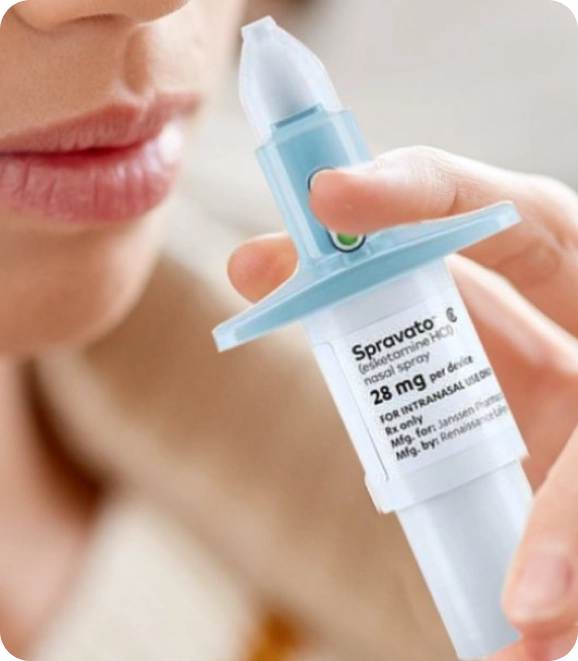
You self-administer the Spravato nasal spray device under direct supervision. The provider is present and guides you through the process. Most doses are two or three devices, five minutes apart, so dosing takes 5 to 10 minutes.
Mild dissociative effects — normal and temporary
Within minutes, you may experience mild dissociation — a dreamy, slightly detached sensation, possible visual distortions, mild dizziness or nausea. This is the expected action of esketamine on NMDA receptors. These effects typically peak around 40 minutes and largely resolve within the 2-hour observation window. Most patients describe it as manageable and not distressing.
2-hour monitored observation
You rest in your private suite while our team monitors your blood pressure, heart rate, and overall wellbeing. By the end of this period, nearly all acute effects have passed. Your provider does a brief assessment before clearing you to leave.
You need a driver home
You cannot drive or operate machinery for the remainder of the day after a Spravato session. Plan ahead — arrange a ride or have someone with you. This is a non-negotiable safety requirement for every session.
Learn more before your visit
Just have a question? We'll call you.
Leave your info and someone on our team will call you. No medical history needed, just a conversation about whether this could help.